

By Mawlana Yusuf Lorgat
Introduction: Hadrat Mawlana Yusuf Motala (d.2019), khalifah of Hadrat Shaykh al-Hadith Mawlana Muhammad Zakariyya Kandhalwi (d.1981) and founder of Darul ‘Uloom Bury, was a pioneer when it came to nurturing and educating Muslims in the west. The sheer large number of his students and institutes, dotted across the UK, Europe and North America is a testimony to what a single man with a purpose and vision, despite little means, can achieve. The below are some personal reflections by one of his students and khalifahs, Mawlana Yusuf Lorgat, a hadith lecturer at Madinatul ‘Uloom, Kidderminster, who introduces readers to an aspect of an individual whose unwavering commitment to nurturing hearts and minds has transformed generations and left a lasting legacy. He saw potential where others saw limitations, and he built pathways where none existed, all in service to Allah Most High. His guidance and foresight continue to shape lives long after his passing. Mawlana Yusuf Lorgat writes:
While still in the fifth year of the Dars-i-Nizami at Darul ‘Uloom Bury, and at just 19 years of age, Hadrat Mawlana Yusuf Motala (may Allah have mercy on him) directed me to prepare a treatise on the life and services (sawanih) of the Grand Mufti of Pakistan Mufti Muhammad Shafi’ Usmani (d.1976) (may Allah have mercy on him).
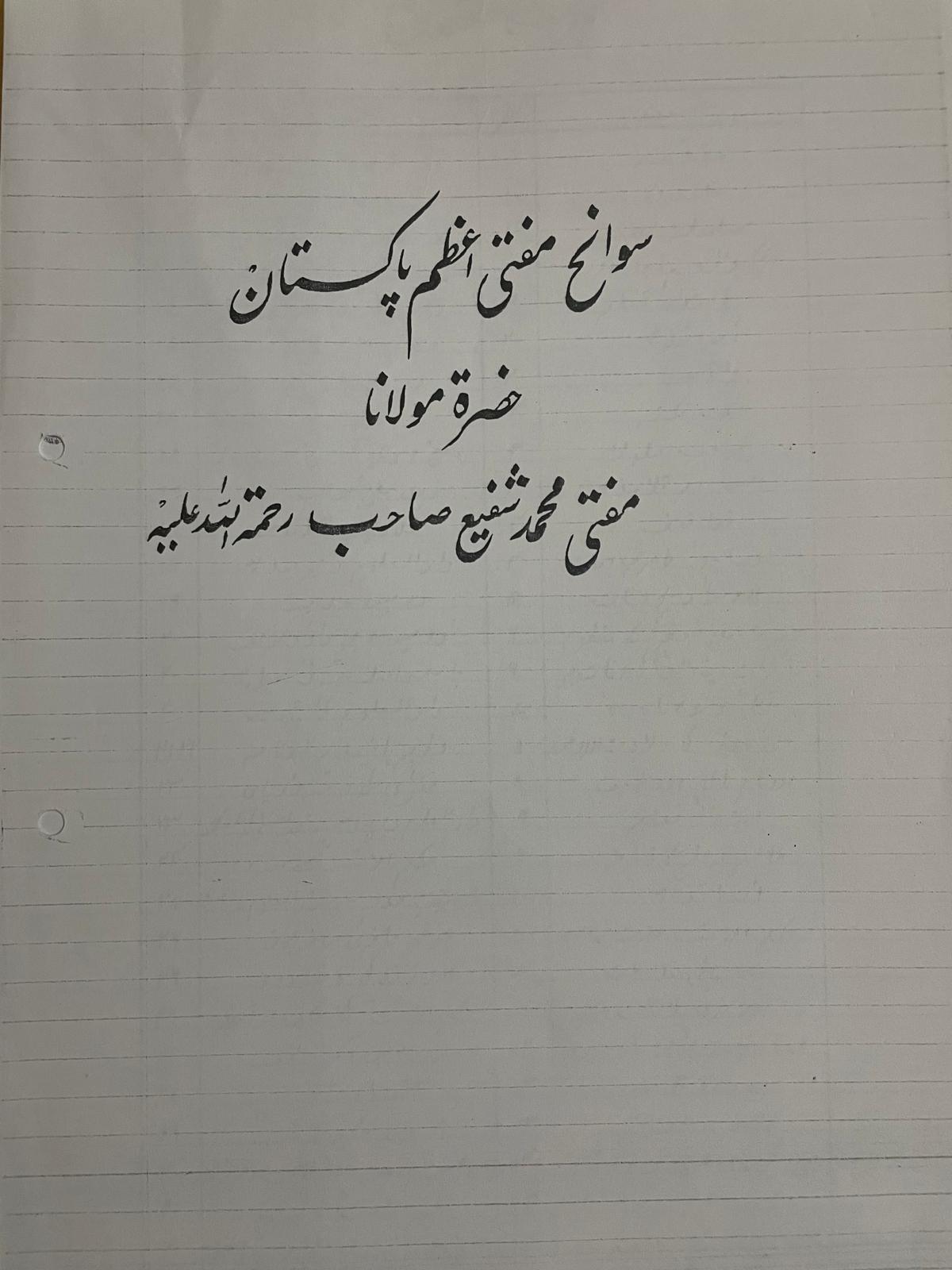 In that paper, which I wrote by hand, I included a foreword, an index, and a detailed account of the major phases of Mufti Shafi‘’s life. This was my first venture into research and writing, something I had the honour of being initiated into at the hands of our Hadrat who, along with overseeing the writing of this paper, provided motivation, encouragement and useful feedback. It also set me on a course of writing that has remained with me ever since. The completed manuscript remained safely preserved with me in a folder for some thirty-five years, and it was during Mufti Taqi Usmani’s recent visit to the UK this year that I was able to present him with a copy in early November.
Hadrat (may Allah have mercy on him) was keen his students developed skills needed to research and write. In my final year of studies at Darul ‘Uloom Bury, I was asked to write an assignment on the glad tidings about the noble Prophet Muhammad (may Allah bless him and grant him peace) in the Torah and Gospel. Writing this paper necessitated a detailed and careful study of both the Old and New Testaments. Engaging in this early research proved formative; it cultivated within me the habit and disciplines needed for academic writing. Through this favour of Allah Most High, these early steps into writing served me well during my BA studies at the Islamic University of Madinah and became a means for me to author several books:
- Nafahat al-Rahmah min Hadith al-Rahmah al-Musalsal bil-Awwaliyyah (The Breezes of Mercy from the Hadith of Mercy Narrated in the Chain of First Transmission)
- Ilhaq al-Sawad bi-Ahadith al-Mishkat allati Taraka al-Khatib Laha al-Bayad
(Completing the Omitted Portions of the Mishkat al-Masabih Where the Compiler Left Blanks) - ‘Uyun al-Nadarah min Hayat al-Shaykh Yusuf Mutarah (The Springs of Radiance from the Life of Shaykh Yusuf Motala)
- Safahat Mushriqah ‘an Madrasat al-‘Ulum al-Shar‘iyyah bil-Madinah al-Munawwarah wa Silat al-Muhaddith al-Shaykh Muhammad Zakariyya al-Kandahlawi Biha (Illuminating Pages on the Madrasah al-‘Ulum al-Shar‘iyyah in al-Madinah al-Munawwarah and its Connection with the Hadith Scholar Shaykh Muhammad Zakariyya al-Kandahlawi)
- Siraj al-Talib al-Nabih li-Kashf Masadir Mishkat al-Masabih – (The Lamp of the Intelligent Student for Uncovering the Sources of Mishkat al-Masabih
- Arba‘una Hadithan min Arba‘ina Kitaban min Masadir Mishkat al-Masabih (Forty Hadiths from Forty Books Among the Sources of Mishkat al-Masabih)
- Al-Arba‘un al-Madaniyyah fi al-Shama’il al-‘Amaliyyah (The Forty Madinan Traditions on Practical Prophetic Traits)
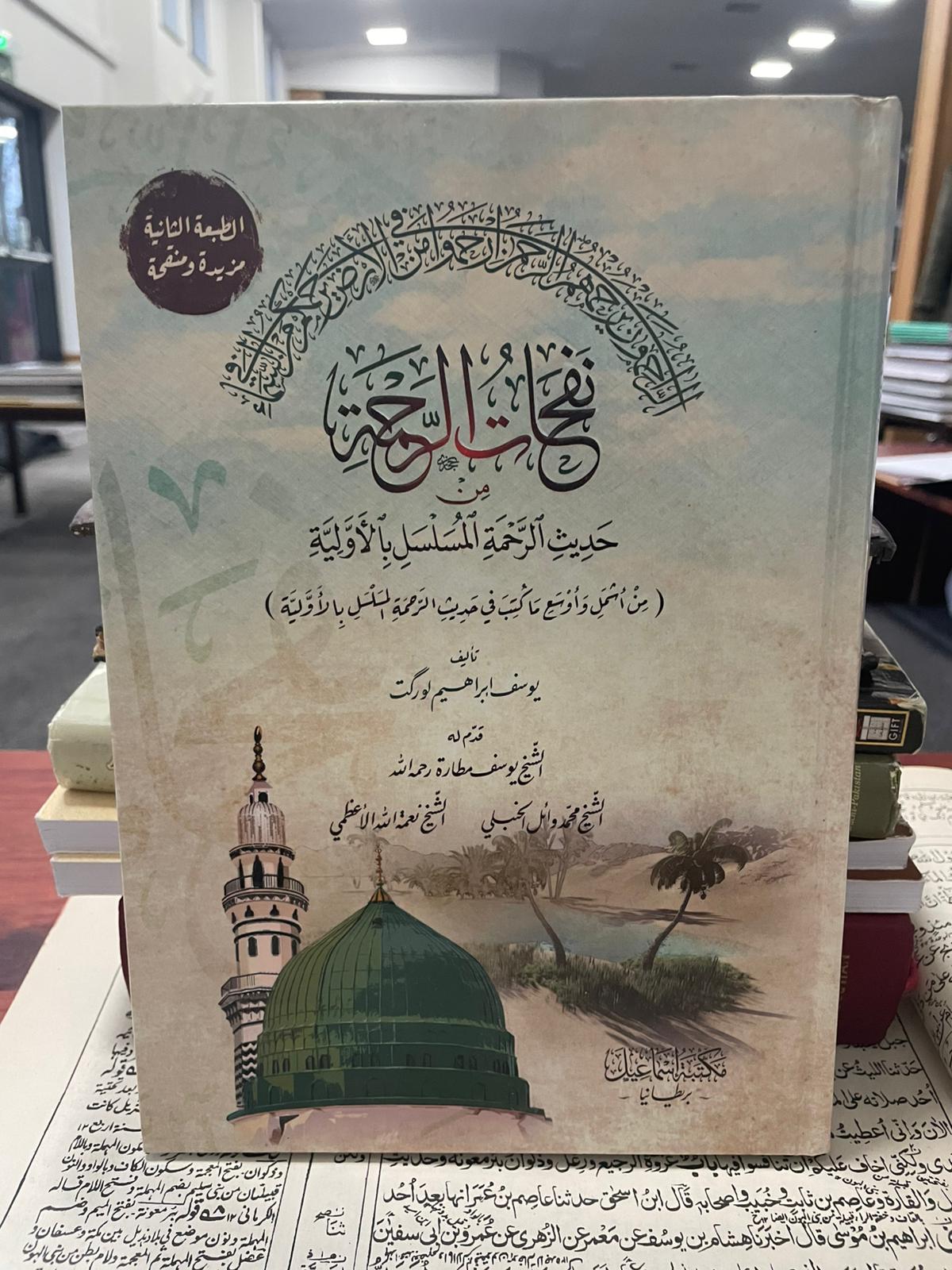 All of this was only possible through the encouragement, nurturing and attention (tawajjuh) of Hadrat Mawlana Yusuf Motala (may Allah have mercy on him) – may Allah Most High enlighten his grave and reward him immensely, amin.
I recall a time when, due to limited financial resources at Darul ‘Uloom, Hadrat (may Allah have mercy on him) would send students such as Mawlana Hanif Dudhwala of Blackburn and others, to the Sunday market to purchase second-hand books. Hadrat (may Allah have mercy on him) had a far-reaching vision. At a time when Islamic secondary schools were practically non-existent and Islamic libraries rare, he established for students at our Darul ‘Uloom two libraries: one consisting of secular English books and another of Islamic books. He also established a much coveted and rich third library that was open to both staff and students. This third library houses a remarkable collection of works. It not only holds excellent critical editions of contemporary books, but over one hundred unpublished manuscripts, some exceedingly rare, acquired from around the globe at a time when the internet did not exist.
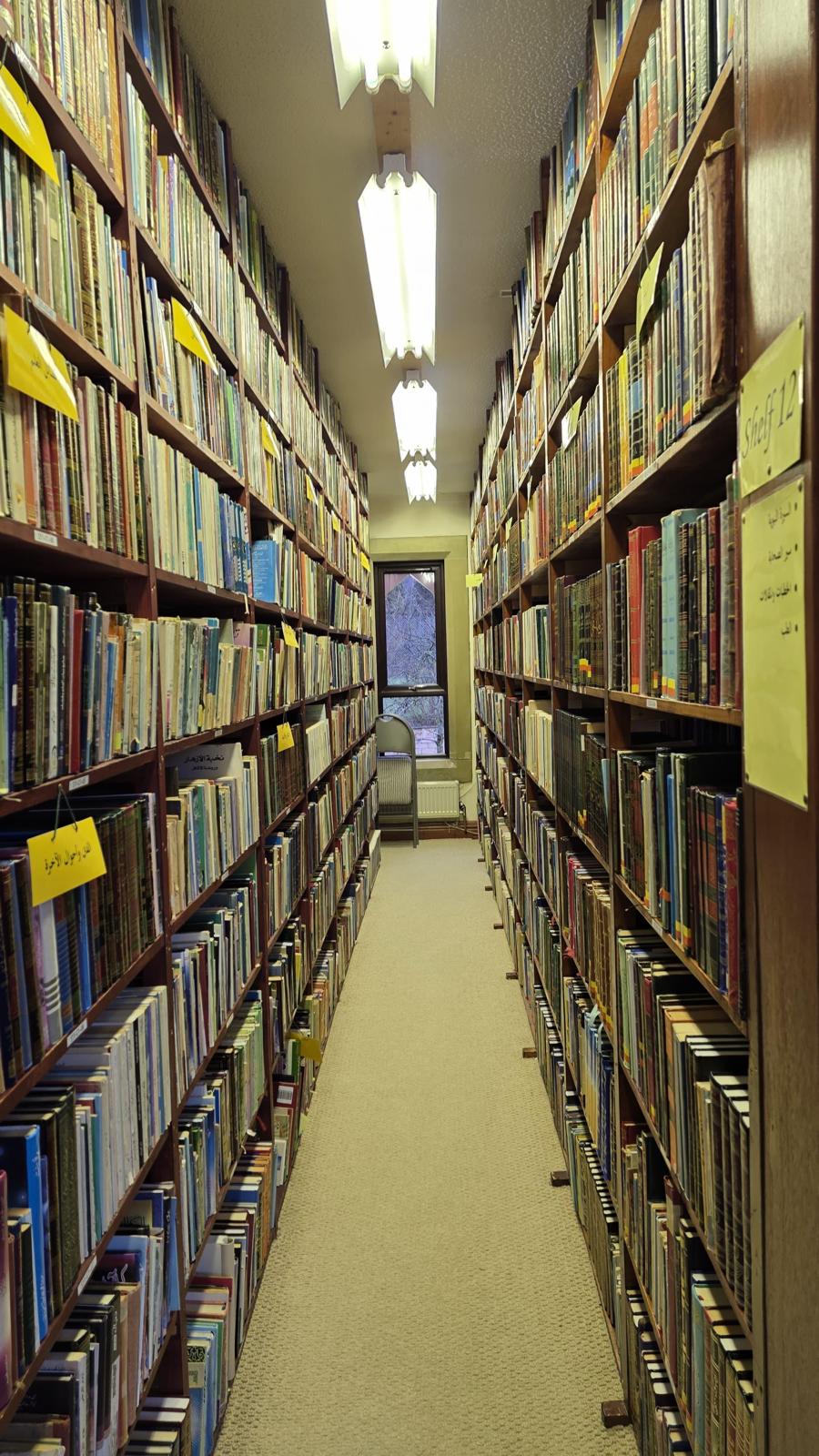
Darul ‘Uloom’s librarian, the much respected and erudite Mawlana Muhammad Dedat (may Allah have mercy on him), would order catalogues from book publishers and sellers from across the world, including from Delhi, Mumbai, Karachi, Lahore, Cairo, Amman and Beirut. He had beautiful handwriting and would send handwritten letters listing the titles, quantities and prices of the books he wanted. These letters were sent out by snail mail, payments would be arranged and books were shipped to Darul ‘Uloom. Hadrat (may Allah have mercy on him) would personally inspect the books that arrived. Any duplicates or works he deemed especially beneficial for students or suitable for the English section were set aside and placed in a separate library adjacent to the main library. This space, which later became the Darul Ifta, was reserved for students with a particular interest in extra-curricular study and research.
When I was a student at Darul ‘Uloom Bury, the students in the fifth and sixth years were given written assignments, the successful completion of which would generate marks that would go to their final examination results. Each fifth-year student was required to complete a 10,000 word assignment, while sixth-year students were tasked with writing a 25,000-word paper. Dedicated research time in the library was allocated between 6pm and 8pm during the evening study period (mutala‘), which would be conducted under Hadrat’s direct supervision (may Allah have mercy on him).
The library that had been set up for secular English books consisted of works on numerous topics, including literature, history and the social sciences. In the 1980s, Hadrat (may Allah have mercy on him) was eager the library had classic English works such as those by Shakespeare and others. His foresight was remarkable, he would instruct Mawlana Hanif Dudhwala and his companions to visit the Sunday boot markets across Lancashire to purchase second hand English books, asking them to collect as many English titles as possible – anything that might interest students, including books on football, sports and popular children’s storybooks such as The Famous Five and The Magnificent Seven by Enid Blyton. Thousands of books were purchased and catalogued at the library. My friend Mawlana Ismaeel Nakhuda mentions he read an Arabic translation of Jane Austen’s Pride and Prejudice that he borrowed from the student library during the second half of the 1990s.
Hadrat’s vision was to broaden students’ knowledgebase, strengthen their proficiency in English through extensive reading, and nurture their writing abilities. Students were permitted to freely borrow and read books. These efforts soon bore fruit. By the 1980s, Darul ‘Uloom students were academically far ahead of their time. Darul ‘Uloom facilitated their enrolment onto A Level courses at Bury College in the evenings – a provision that many Muslim seminaries, even today in 2025, have yet to establish. Hadrat (may Allah have mercy on him) would actively encourage students to pursue studies at Bury College to pursue their secular education. Thus, students who had begun their journey in the hifz and ‘alimiyyah classes would, after completing their GCSEs, progress to A Levels. Many continued to university and later became professionals – doctors, lecturers and experts in various fields, serving their communities with distinction. All of this was facilitated under the guidance and vision of Hadrat (may Allah have mercy on him).
In later years, teachers of the final year of the Dars-i-Nizami were asked not to teach during the day when the final year Bukhari students attended the then University of Central Lancashire. The Darul ‘Uloom had arranged accreditation with the university, allowing students to enrol on to university degree courses. Mawlana Ismaeel Nakhuda, who also began studies at the University of Central Lancashire that year, recalls once Hadrat advising students who had enrolled at the university saying that he is not sending them to university to ruin them (bigarne ke liyeh), or to acquire worldly means (dunya kamaneh keh liyeh), but to make them more beneficial to society by combining religious and modern education.
Through this arrangement, many students began degrees while finishing off their ‘alimiyyah studies, and later advanced to Master’s and doctoral programmes. Today, Darul ‘Uloom Bury proudly counts among its graduates huffaz, ‘ulama and numerous PhD holders. This was the far-reaching vision of Hadrat (may Allah have mercy on him) who himself spoke only a few words of English.
This system encouraged Darul ‘Uloom graduates to pursue further studies and equipped them with the skills for academic writing, enabling them to produce scholarly articles and author works. All of this was through the barakah, dua‘, and farsightedness of Hadrat (may Allah have mercy on him). He never diminished the importance of the ‘alimiyyah programme; rather, he envisioned students should excel in both din and dunya, so they could engage meaningfully with a variety of audiences and wider society.
To honour the achievements of students who completed their PhDs, Hadrat (may Allah have mercy on him) hosted special graduation ceremonies. One such event was held on Tuesday 23 October 2018 in the presence of Hadrat Mawlana Sa‘d Kandhalwi, who was visiting Dewsbury for an ijtima‘. Hadrat (may Allah have mercy on him) invited him to Darul ‘Uloom Bury where, in front of thousands, the accomplishments of students who had recently completed their doctorates from British universities were celebrated and presented with certificates. An invitation card was prepared for the occasion, and Hadrat (may Allah have mercy on him) had the following written: Dars-i-Hadith-i-Rahmah and words of advice to those students who have attained a doctorate degree…
A poster was also circulated on social media a week before, at a time when Hadrat (may Allah have mercy on him) did not know that my book Nafahat al-Rahmah would arrive just one day before the event. There had been no prior discussion between Hadrat (may Allah have mercy on him) and I regarding presenting the book on that occasion. Moreover, Hadrat (may Allah have mercy on him) had never titled a poster with Dars-i-Hadith al-Rahmah. This was, in truth, a miracle of Hadrat (may Allah have mercy on him).
On Monday afternoon, Hadrat (may Allah have mercy on him) called me and instructed me to bring the first copies of Nafahat al-Rahmah, saying, “We will present the first copy of your book to Hadrat Mawlana Sa‘d.” Complimentary copies were also distributed to senior ‘ulama on the day.
Even on that blessed occasion, Hadrat (may Allah have mercy on him) gave precedence to ‘alimiyyah studies over all else. On the morning of the programme, as Hadrat (may Allah have mercy on him) entered the masjid before thousands, and before the names of the PhD students were announced, he personally called me to present the first edition of Nafahat al-Rahmah to Hadrat Mawlana Sa‘d. The book had only arrived from Istanbul the previous morning, Monday 22 October. It was after this that the PhD graduates were called out: Mawlana Dr Ashraf Makadam, Mawlana Dr Mansur Ali, Mawlana Dr Imran Mulla and Mawlana Dr Omair Malik. Mawlana Dr Mahmood Chandia, who graduated in 1998, was celebrated separately on an earlier occasion.
This order of events was deeply symbolic. Even while honouring academic excellence, Hadrat (may Allah have mercy on him) gave importance to Hadith, the words of the Messenger (may Allah bless him and grant him peace), over all else. In that single gathering, both forms of knowledge were celebrated side by side, reflecting his lifelong principle: the fusion of spiritual and intellectual excellence, where sacred knowledge remains central but worldly learning complements it in the service of din.
Hadrat Mawlana Yusuf Motala (may Allah have mercy on him) was a man of remarkable simplicity, yet his vision transcended boundaries. He dreamt not merely of producing scholars, but of nurturing complete human beings — spiritually refined, intellectually capable and socially engaged. In truth, his legacy remains an enduring beacon for institutions across the world.
Leave A Comment